Sourcing Guide
How Wholesale Buyers Can Confirm Pokémon TCG Stock Before Shipping
A practical stock-confirmation process for checking product version, quantity, packaging condition, evidence, reservation terms, and carton details before a wholesale order ships.
August 3, 2026 · 8 min read
Introduction
A wholesale stock check should answer a simple question: does the supplier have the exact product, version, quantity, and condition that the buyer expects? A screenshot of a product listing does not answer that question. Neither does a message saying that stock is available without identifying which stock is being discussed.
For Pokémon TCG products, small differences matter. Two boxes can belong to the same broad release while containing different pack formats. A Simplified Chinese product can also be confused with a Traditional Chinese, Japanese, or English product when the language version is not written clearly. Confirming stock therefore means matching physical goods to a written order before payment milestones and again before dispatch.
This guide provides a repeatable process for streamers, resellers, collectors, and small card shops. It does not require complicated software. A clear product list, dated evidence, and two deliberate checkpoints are usually enough to prevent the most common misunderstandings.
Define What “Stock Confirmed” Means
Stock is confirmed only when four elements agree: product identity, physical evidence, available quantity, and timing. If one element is missing, the buyer still has an assumption rather than a complete confirmation.
Product identity describes exactly what is being purchased. Physical evidence connects that description to goods that can be seen. Available quantity shows how many units can be allocated to the order. Timing explains how long that allocation remains valid and when the next check will happen.
This distinction is important because several phrases can sound similar while meaning different things:
None of these situations is automatically wrong. The problem begins when the buyer and seller use the same word for different situations. Ask for the status in plain language and make the answer part of the order record.
- In stock usually means units are physically available now.
- Available from a partner may mean the seller still needs to obtain the goods.
- Incoming stock means the goods have not reached the seller yet.
- Allocation or preorder refers to an expected quantity rather than completed physical inventory.
- Reserved stock means identified units are being held for a named order during an agreed period.
Lock the Product Identity in Writing
Before asking for photos, create one line for every product. Each line should be specific enough that a warehouse team could select the item without relying on memory.
Record:
The unit of measure deserves special attention. Ten cases, ten display boxes, and ten packs are completely different orders. Write both the number and the unit on the quotation, invoice, packing list, and confirmation message.
The official Pokémon website in China shows why format details matter: one Simplified Chinese Scarlet & Violet release was offered in both five-card and twenty-card booster formats. A set name by itself would not identify which format a buyer intended to order. GS1 likewise treats a GTIN as an identifier for a specific trade item that can be ordered or invoiced. When a reliable product code is visible, recording it gives both parties a cleaner reference than a shortened product nickname.
- Exact language version: Simplified Chinese, Traditional Chinese, Japanese, or English
- Product and expansion name
- Product format: booster box, booster pack, deck, collection box, singles bundle, or theme bundle
- Pack or card configuration when it affects the order
- Supplier SKU, manufacturer product number, barcode, or GTIN when available
- Condition expectation: opening-grade, clean sealed retail stock, or a separately agreed display standard
- Quantity requested and the unit of measure
Ask for Evidence That Matches the Order
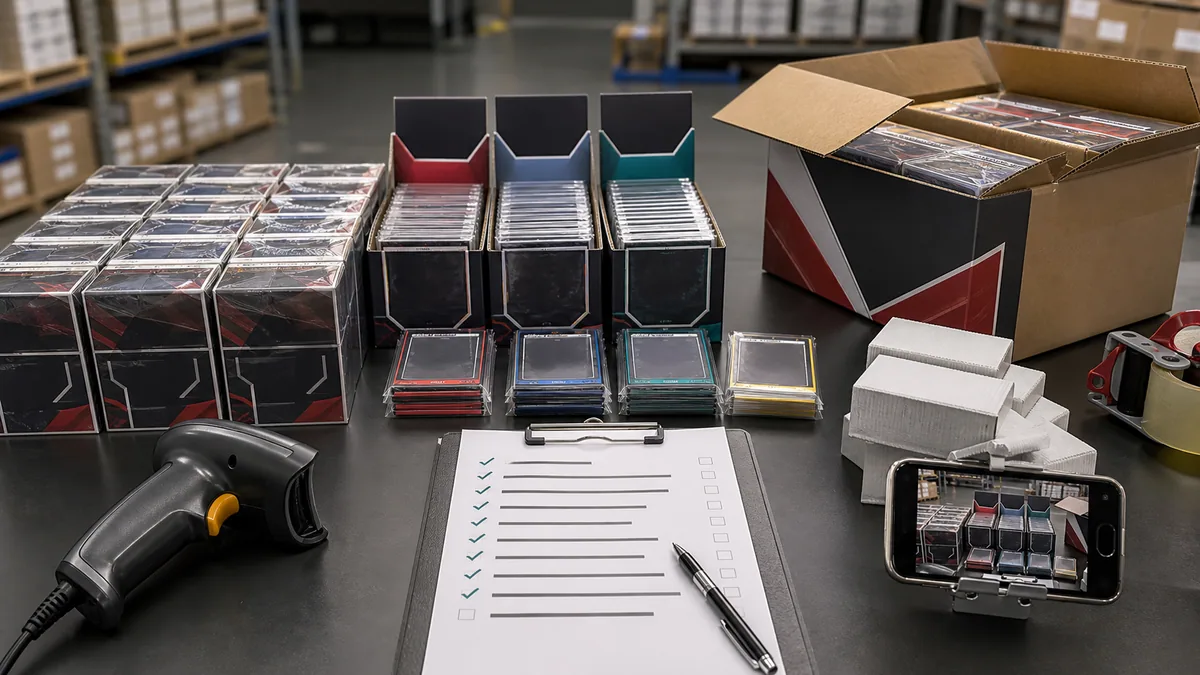
Useful evidence should connect the physical stock to the written product list. It should not force the buyer to guess whether the image is recent or whether the photographed cartons belong to another customer.
For a modest order, request a dated photo showing the products together with a simple reference note. The note can contain the buyer initials, quotation number, or order reference and the current date. It should not display payment details, private addresses, passwords, or other sensitive information.
A practical evidence set includes:
Ask whether the images show the actual units allocated to the order or representative stock of the same product. Representative photos can help identify a product, but they do not confirm the condition of the units that will ship.
The goal is not to demand a studio photo shoot. It is to create enough evidence that the buyer can compare the quotation, the visible products, and the later packing list without ambiguity.
- One wide photo showing the overall quantity
- A closer photo of the front and side of each product type
- A clear view of language, product number, or barcode details when available
- Close-ups of seals, corners, and outer packaging when condition matters
- A short continuous video for larger or mixed orders when still photos cannot show the count clearly
Separate Quantity Confirmation from Condition Confirmation
A supplier may have the correct quantity while some units do not meet the buyer’s packaging expectations. Check quantity and condition as separate items.
For sealed products, inspect whether the retail box is closed, whether seals appear intact, and whether corners or panels show visible crushing. For live openings, light exterior wear may be acceptable if the inner product remains protected. For sealed resale, the same wear may need to be disclosed and separated from cleaner units.
For singles or curated bundles, confirm the counting method and the promised composition. A 100-card mixed bundle might be counted by total cards, while a character bundle might need a fixed list or clearly stated selection rule. The evidence should match the way the product is described to the end customer.
Avoid using authenticity and condition as interchangeable words. An authentic product can still have damaged packaging, and a clean-looking package is not by itself proof of origin. Product identity, sourcing records, seals, condition, and quantity are different checks. Our authenticity and sourcing page explains these checks in more detail.
Agree on a Reservation Window
Physical stock can change while a buyer compares freight, confirms a budget, or waits for an internal approval. The stock-confirmation message should therefore include a time limit.
Ask:
A short written reservation window is clearer than an open-ended promise. It protects the buyer from assuming units are still held and helps the supplier manage other enquiries. If the window expires, repeat the quantity check rather than relying on the earlier photo.
- Is the quantity merely available, or has it been reserved for this order?
- When does the reservation expire?
- Does the reservation require a deposit?
- What happens if the buyer changes the product mix?
- Will the supplier reconfirm before requesting the remaining payment?
Use Two Stock-Confirmation Checkpoints
One confirmation is not always enough for an international wholesale order. Use one checkpoint before the main payment decision and another before dispatch.
At the first checkpoint, match the quotation to the product list, evidence, quantity, condition, and reservation terms. Resolve substitutions before money moves. If a product is incoming rather than physically held, write that status clearly and agree on what evidence will be provided after arrival.
At the pre-dispatch checkpoint, review the final packing list and any changes made after the first confirmation. Confirm the carton count, quantity by SKU, language version, condition exceptions, and the products visible in packing photos. The shipping record should describe what is actually inside the cartons, not what appeared on an earlier quotation.
For mixed orders containing sealed products, theme bundles, and streamer live packs, use a separate line for each format. This makes both inventory control and delivery inspection easier.
Watch for Common Red Flags
A single imperfect photo does not prove there is a problem, but repeated gaps deserve clarification before payment or dispatch.
Pause and ask questions when:
The practical response is not accusation. Ask for a corrected product line, a clearer image, an updated packing list, or a second confirmation. Good records make it easier for both sides to fix an honest warehouse mistake.
- The supplier avoids stating whether goods are physically in hand
- Product photos do not show the requested language or format
- The visible quantity is much smaller than the quantity being invoiced and no warehouse explanation is provided
- Images appear repeatedly reused but are described as current allocated stock
- Product codes on the photos do not match the quotation
- The seller changes products or quantities without updating the written order
- Collector-grade condition is promised without showing corners, seals, or box surfaces
- The reservation has no expiry time and no reconfirmation point
- The final packing list differs from the agreed product list
Buyer Stock-Confirmation Checklist
Before approving the order for dispatch, confirm:
Keep this record with the quotation and later compare it with the shipment on arrival. The process takes a little time, but it gives the buyer a much stronger basis for receiving checks, inventory entry, and any necessary supplier follow-up.
If you are comparing Simplified Chinese Pokémon TCG sealed products, theme bundles, or live-pack formats, review our Chinese Pokémon TCG wholesale, sealed products, theme bundles, and streamer live packs pages. For help preparing a product-and-quantity list, contact Legendary TCG Vault through the Get Quote page or WhatsApp with your destination country and approximate order range.
- Exact language version for every item
- Full product name and format
- SKU, product number, barcode, or GTIN when available
- Quantity and unit of measure
- Physical-stock, incoming-stock, preorder, or partner-stock status
- Dated photos or video linked to the order reference
- Actual allocated units versus representative photos
- Seals and packaging condition
- Agreed substitutions, if any
- Reservation period and payment milestone
- Final packing list and carton count
- Shipping destination and delivery contact
Sources
Disclaimer
Legendary TCG Vault is an independent trading card wholesale supplier. We are not affiliated with Nintendo, Game Freak, Creatures, or The Pokémon Company.