Sourcing
How Resellers Should Source Pokémon Promo Cards for the Way Collectors Buy
Collectors buy promo cards for certainty, competition, or the reveal. Source reseller inventory backward from the sales channel instead of treating random bulk as consumer demand.
August 31, 2026 · 9 min read
Introduction
Three collectors can look at the same Pokémon promo card and be buying three different things.
One searches a marketplace for the exact card, checks the card number, language, condition, and price, then chooses the listing that matches the collection. Another watches a livestream host hold that card in front of the camera while a short auction countdown runs. The card is known, but the final price is not. A third customer buys a sealed promo product because finding out which card is inside is part of the fun.
All three customers want Pokémon cards. They are not buying the same experience.
That difference should shape wholesale sourcing. Before a reseller asks whether to buy sealed products or individual promo cards, the better question is: What will the end customer actually buy—certainty, competition, or the reveal?
Do Not Confuse a Wholesale Lot With a Consumer Purchase
A supplier may buy or sell 100 random promo cards, 500 mixed singles, a sealed case, or a collection acquired from several market sources. Those are wholesale inventory units. They make sense upstream because a reseller can divide, list, auction, bundle, or redistribute the stock.
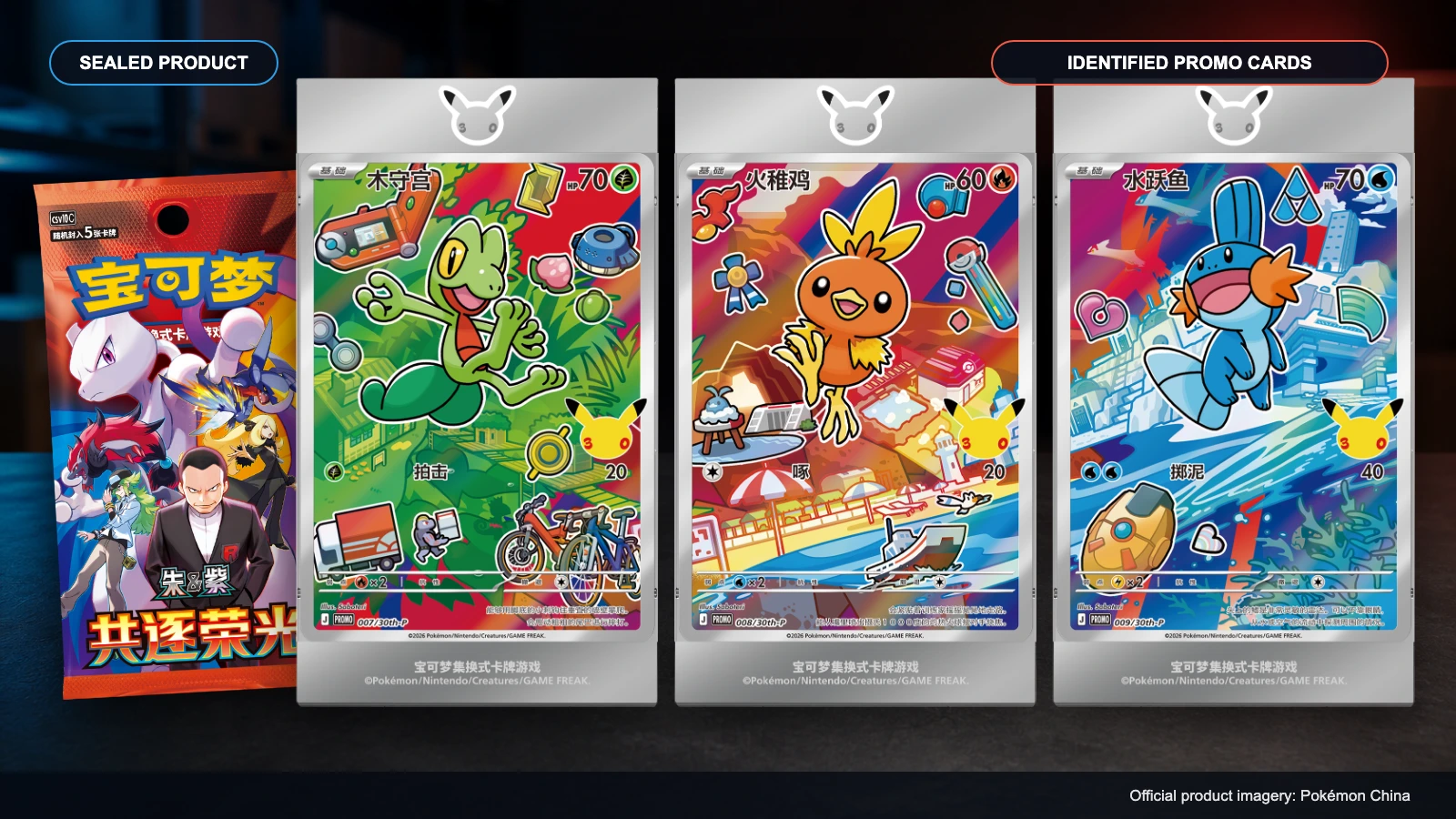
The end consumer usually encounters a different offer. A collector might buy one exact Treecko promo, bid on a Torchic card shown in an auction, or open a sealed product containing one random promo. The reseller has turned upstream inventory into a retail purchase the customer can understand.
This boundary matters because a mixed lot is not proof of consumer demand. It is an inventory pool. Its usefulness depends on what the reseller can make from it. A livestream seller may use the cards as individual auction lots. A vending operator may need lower-cost singles that fit known slots. A marketplace seller may create exact listings. Without a channel plan, the same bulk lot can become duplicate-heavy stock with no clear route to the customer.
Exact-Card Buyers Are Purchasing Certainty
An exact-card buyer already knows the desired outcome. The purchase may begin with a Pokémon, an artwork, a card number, a set, or a language version. Condition and seller credibility then help the buyer choose between listings.
TCGplayer's current seller guidance, for example, tells sellers to match the correct catalog version and enter quantity and condition for the item being listed. The commercial promise is straightforward: the listed card is the card the buyer expects to receive.
For a reseller, this requires inventory that can be described precisely. “Pokémon promo card” is not enough. A useful listing distinguishes the exact card, language, version, card number, and condition.
The main inventory risk is not randomness. It is depth in the wrong cards. A mixed purchase can contain attractive singles while still leaving the seller with characters, versions, or conditions that move slowly in that particular audience. The reseller therefore needs to understand search demand and acceptable duplication before increasing quantity.
Auctions Sell a Specific Card Through Competition
An auction does not make the card itself random. The buyer sees the item being offered; what remains open is the final price and who wins it.
In a traditional online auction, the seller chooses a starting price and buyers bid against one another until the listing ends. eBay's official auction guidance describes the highest bidder winning at the end. The result reflects the card, the bidders present, the ending time, their maximum bids, and the competition during that particular listing.
A livestream auction puts the same known card into a more immediate setting. On Whatnot, for example, the seller sets the starting bid and auction time, buyers bid in real time, and the countdown can respond to new bids depending on the timer format. The host is also presenting the card while the audience reacts.
That changes the purchase context. Character attachment, visual appeal, trust in the host, the explanation given on camera, activity from other viewers, and the pressure of a countdown can all influence the decision. This does not mean every live purchase is irrational. It means the card is only one part of the environment in which the price is reached.
For inventory planning, cards that work in live auctions are usually easy to recognize, visually clear on camera, and simple to describe within a short selling window. Condition should be easy to show and explain. The seller also needs a starting price they can accept if competition is weak.
One strong livestream result should not automatically be treated as a stable market price. A different host, audience, time, or level of competition can produce a different outcome for the same card.
Sealed Products Sell the Reveal
A sealed buyer is not necessarily confused about the product. The customer can know exactly which box, pack, or random promo product is being purchased while accepting that the card inside is unknown.
The uncertainty is part of the offer. Opening the package, revealing the card, and sharing the result with a host or other viewers can provide entertainment beyond the resale value of the contents.
Pokémon China's 30th Anniversary First Partner Special Illustration Card Set Vol. 3 is a clear current example. The official product description states that the set includes one randomly selected promo from nine designs, along with a magnetic display frame and a booster pack. A buyer can understand the product while still not knowing which promo will appear.
For resellers, this makes seal integrity and disclosure commercially important. The listing or livestream should explain the random rule without suggesting that a requested Pokémon is guaranteed. If the product has been opened and the card is known, it has become a different consumer offer: a specific promo card or an opened product with stated contents.
The reseller should preserve separate inventory for these jobs. Exact singles serve collectors who want certainty. Intact products serve customers who value the reveal. Trying to promise both from the same sealed unit creates the wrong expectation.
What Random Bulk Inventory Is Actually For
Random 100-card or 500-card lots can be useful, but their role is usually upstream of the consumer purchase. A reseller may acquire mixed stock to keep livestream auctions moving, fill vending inventory, create lower-cost singles listings, or build a broad inventory pool for future selection.
The value of the lot depends on the reseller's ability to use its distribution. Duplicate tolerance, character mix, language, condition, rarity mix, and the sales channel all matter. A live-auction seller may absorb variety differently from a specialist store built around exact card searches.
The operational question is not simply whether the bulk price looks attractive. It is whether the business has a believable path from mixed inventory to customer-facing offers. If that path is missing, low acquisition cost can be offset by slow-moving cards and time spent managing stock that the audience did not ask for.
Bulk is therefore a reseller inventory tool, not consumer demand by itself.
Source Backward From the Way You Sell
| Sales model | What the consumer is buying | Suitable inventory | Main risk |
|---|---|---|---|
| Fixed-price marketplace | An exact card and certainty | Specific singles with accurate version and condition | Slow-moving cards or excess duplicates |
| Traditional auction | A shown card plus price discovery | Individual cards suitable for auction | An uncertain closing price |
| Livestream auction | A shown card plus host trust, urgency, and competition | Visually clear singles that fit the audience | Results that depend heavily on the room and timing |
| Sealed opening | The reveal and entertainment | Intact packs, boxes, or clearly disclosed random promo products | Implying an outcome that is not guaranteed |
| Reseller bulk sourcing | A flexible inventory pool for later retail offers | Mixed or random lots the seller can reorganize | Duplication and dead stock |
This table is not a rule that every reseller must choose one model. Many businesses use several. The important step is to keep the inventory pools and customer promises clear.
A card shop might buy exact singles for searchable listings while carrying a smaller sealed range. A livestream seller might combine known-card auctions with sealed openings, but should explain which experience is being sold each time.
The Practical Buying Decision
Before placing the wholesale order, write down how the stock will reach the end customer.
If the business relies on fixed-price listings, prioritize cards that can be identified, graded by condition, and matched to real searches. If it relies on traditional auctions, choose cards that justify individual listings while accepting that the closing price can vary. If it relies on livestream auctions, consider how quickly the card can be understood on camera and whether it fits the host's actual audience. If the offer is an opening experience, protect the sealed format and state the random outcome honestly.
Only use random bulk as the starting point when the business has a realistic way to turn that pool into retail products. The quantity is secondary to the sales route.
Resellers can review our Chinese Pokémon singles and bundles, streamer live-pack formats, and sealed product sourcing pages when comparing inventory models.
Tell us how you sell—fixed-price singles, auctions, sealed openings, or mixed inventory—and the approximate quantity you need. We can then compare suitable options and check current availability through our quote request page.
Sources
Disclaimer
Poke Wholesale is an independent trading card wholesale supplier. We are not affiliated with Nintendo, Game Freak, Creatures, or The Pokémon Company.