Wholesale Guide
A 5-Step Inspection Checklist for Wholesale Pokémon TCG Buyers
Your shipment just cleared customs. A pallet of booster cases — or maybe a dozen display boxes — sits in your warehouse, your living room, or the back of your shop. The tracking says “delivered.” Your supplier...
July 1, 2026 · 9 min read
Introduction
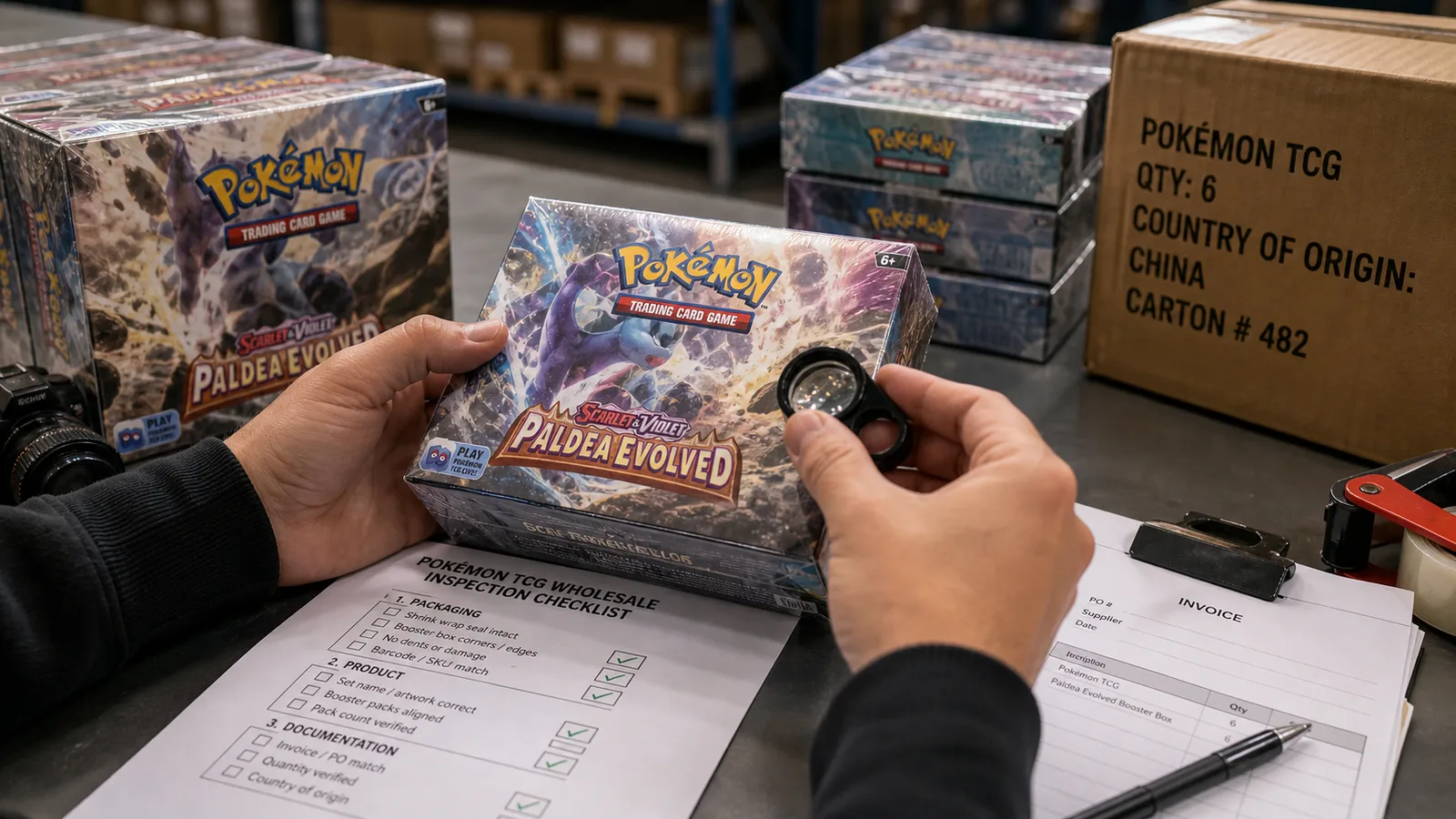
Your shipment just cleared customs. A pallet of booster cases — or maybe a dozen display boxes — sits in your warehouse, your living room, or the back of your shop. The tracking says “delivered.” Your supplier sent the invoice. Time to list everything for sale and start moving units, right?
Not yet.
Delivery is not the finish line. Inspection is.
Here’s a real scenario from a buyer in Germany last year: a reseller ordered twenty-four Scarlet & Violet booster cases from a supplier they’d used twice before. Trust was established. Customs clearance went smooth. The outer pallet wrap looked clean. They signed the delivery receipt, broke down the pallet the next day, and started shipping individual boxes to their retail customers. Three days later, a customer emailed photos of dented booster boxes — corner creases deep enough to split the cardboard, visible through the shrink wrap. Four boxes from the bottom layer of the pallet had absorbed impact damage somewhere between the factory and the final mile. The reseller had already signed for “clean” delivery. Without photo evidence taken at arrival, the freight forwarder denied liability. The supplier, while sympathetic, pointed to a signed delivery receipt with no damage notation. That reseller ate a $1,200 loss on product they couldn’t sell at retail.
This happens more often than most wholesalers want to admit. International freight involves multiple handoffs — factory to export warehouse, container loading, ocean or air transit, customs inspection, deconsolidation, last-mile delivery. Every touchpoint is an opportunity for impact damage, water exposure, or handling errors.
A 20-minute inspection on arrival protects a $5,000–$50,000 order.
This checklist breaks down exactly what to do, in order, before you sign anything, before you break seals, and before you tell your supplier everything looks good.
Check 1: Outer Carton and Packaging Integrity
Start with what you can see before opening anything.
Inspect the shipping carton or pallet wrap for visible damage. Look for corner dents, punctures, water stains, or crushed edges. If your shipment arrived on a pallet, check whether the pallet itself is broken — a snapped slat often means weight shifted in transit, and that pressure had to go somewhere.
Examine inner packing materials. Wholesale TCG shipments should use a combination of:; Bubble wrap around individual booster cases or display boxes; Foam corner guards or edge protectors on case packs; Air cushions or void fill preventing movement inside the carton; Double-walled cardboard for international shipments
If your shipment arrived with minimal padding — newspaper, thin single-ply cardboard, or loose boxes rattling around — that alone is worth photographing and flagging to your supplier. Good suppliers ship TCG product like it’s fragile, because it is.
Check original case seals if applicable. Booster cases from manufacturers like Pokémon TCG come with factory case tape or sticker seals. Verify these are intact and unbroken. A sliced seal on a booster case is a red flag — it may indicate customs inspection, but it can also signal tampering or resealing.
Understand the difference between opening-grade and collector-grade packaging.
If you ordered collector-grade and the outer case has a fist-sized dent in the lid, that’s a problem. If you ordered opening-grade and there’s minor scuffing on a corner, that’s normal — document it, but don’t escalate.
Photo documentation tip: Take photos of the unopened shipping carton from all six sides before cutting any tape. Timestamp these. If damage is visible, take close-ups with a coin or ruler in frame for scale. These photos are your evidence chain if you need to file a claim.
- Grade
- Acceptable Outer Box Condition
- Target Use Case
- Collector-grade
- Near-mint: no corner wear, no wrap marks, no dented edges, clean display surfaces
- Sealed inventory for long-term hold, high-end resale, graded case submission
- Opening-grade
- Light corner wear acceptable, minor wrap marks okay, no structural damage to box integrity
- Livestream openings, pack sales, retail customers who intend to open
Check 2: Quantity and SKU Verification
With packaging documented, now verify you actually received what you paid for.
Cross-check against your packing list, item by item. Every wholesale order should include a packing list — either printed inside the box, emailed beforehand, or both. Read it before you open anything. Know exactly how many cases, how many display boxes, and what SKUs you’re expecting.
Verify quantities at the case level first. If your packing list says 6 booster cases, count 6 booster cases before opening any of them. Don’t get halfway through unboxing and realize you’re short — you’ll have mixed opened and unopened product, and your documentation gets messy.
Spot-check pack counts inside randomly selected boxes. Open 1–2 booster boxes from different positions in the shipment (one from the top layer, one from the bottom). Verify the pack count matches specification:; Standard Sword & Shield and Scarlet & Violet booster boxes: 30 packs per box; Special expansion display boxes (e.g., 151, Paldean Fates): pack counts vary — verify against the specific set; Elite Trainer Boxes and collection boxes: count the sealed packs inside against the product description
This takes five minutes and catches one of the most common supplier errors — wrong configuration shipped, or a repacked box with fewer packs than spec.
Check for wrong items or missing items alongside your main order. Did you also order promotional items, card sleeves, or playmats? Are they present? Are the expansion sets correct — did you order Scarlet & Violet: Temporal Forces and receive Twilight Masquerade instead? SKU mix-ups happen, especially when set names are similar or product packaging looks alike.
If you find a discrepancy:; Stop opening. Do not open more product.; Photograph the packing list next to the actual items received.; Note the specific shortage, wrong item, or missing product with counts.; Contact your supplier before signing any delivery confirmation or “received in good order” document.
Check 3: Condition Spot-Check by Grade
Now open a representative sample and inspect the actual product condition.
Collector-Grade Inspection
If you’re buying for collector-grade inventory — sealed holds, graded case submissions, premium resale — inspect the product surface carefully:
- Corners: Must be crisp, no softening, no creasing. Run your finger along each corner. A soft corner on a sealed booster box devalues it for collectors.
- Wrap marks: Shrink wrap should be tight and even. Loose wrap, wrinkles under the film, or heat-seal burns are defects.
- Dented edges: Any depression in the cardboard that breaks the surface plane is damage. “Shelf wear” is not acceptable at collector grade.
- Display surfaces: The front, back, and sides should be clean — no scuffs, sticker residue, or printing errors visible through the wrap.
Opening-Grade Inspection
If you ordered opening-grade product — the bulk of what livestreamers and pack sellers move — your standards relax but don’t disappear:
- Corner wear is acceptable if it doesn’t penetrate the wrap or affect pack integrity inside.
- Minor wrap marks from pallet stacking are normal.
- The box must still be structurally intact — no holes, no crushed panels, no water damage.
- Internal packs must be sealed and undamaged. A crushed box corner that doesn’t reach the packs inside is cosmetic. A crushed box that compressed the inner packs is a problem.
Common Defects to Flag
When to accept vs. when to flag:; Acceptable: Cosmetic scuffs, minor corner softening on opening-grade, wrap wrinkles from temperature changes in transit.; Flag immediately: Water damage, mold smell, opened seals, missing packs, structural box damage, wrong expansion set.
- Defect Type
- Collector-Grade Verdict
- Opening-Grade Verdict
- Soft/crushed corner
- Reject
- Accept if wrap intact
- Shrink wrap tear
- Reject
- Accept if small, no exposure
- Dented case edge
- Reject
- Accept if shallow
- Water stain on box
- Reject
- Reject — always
- Misaligned wrap seam
- Accept
- Accept
- Printing defect on wrap
- Reject
- Accept
- Loose packs inside box
- Reject
- Reject — count mismatch risk
Check 4: Product Version Confirmation
A mistake that catches even experienced buyers: receiving the wrong language version or mislabeled product.
Verify you’re actually receiving Simplified Chinese (CS) product. Mainland China Pokémon TCG cards are printed in Simplified Chinese with distinct packaging — expansion set logos, copyright text, and card backs carry specific identifiers. Compare against reference images if you’re unfamiliar. A supplier shipping Traditional Chinese (CT — Taiwan/Hong Kong) product labeled as CS is a serious error that affects your customers and your credibility.
Confirm the expansion set matches your order exactly. Check the set name on the box against your invoice. Some sets have similar names or overlapping artwork:
The box art, set symbol, and product code (usually printed on a side panel sticker) are your verification points.
Verify limited edition numbers if applicable. Some releases — like special illustration collections or collaboration boxes — carry edition numbers or serial indicators. If your order specified a particular print wave or limited run, confirm the batch codes match.
Compare packaging format differences vs. English or Japanese products you’re more familiar with. Simplified Chinese booster cases often pack differently than English equivalents. A standard English booster case contains 6 booster boxes of 36 packs each. Simplified Chinese configurations differ — cases may contain different box counts or pack-per-box ratios depending on the set and print run. Don’t assume the format matches English product. Check the case configuration printed on the manufacturer’s label.
- Scarlet & Violet base set vs. Scarlet & Violet: Paldea Evolved
- 151 (special expansion) vs. main series booster boxes
- Paldean Fates (special set) vs. Scarlet & Violet: Paradox Rift
Check 5: Save Your Documentation
Your inspection isn’t complete until your records are complete.
Unboxing video or photos are your dispute resolution insurance. If you find damage, shortages, or wrong items, your supplier needs evidence. A continuous unboxing video — shot from carton opening through individual box inspection — is the strongest evidence you can provide. Even photos with timestamps work if video isn’t practical.
Store your documentation in a dated folder structure:
/Inspection_Records/ /2025-07-15_TemporalForces_6Cases/ 01_outer_carton_photos/ 02_packing_list_and_invoice/ 03_spot_check_opened_boxes/ 04_condition_documentation/ 05_final_receipt_or_issue_report/
If you find issues, contact your supplier immediately. Contact your supplier with your order number, photos, and a clear description of the discrepancy. The sooner you report, the faster resolution happens. Waiting three days and then claiming transit damage weakens your position — report within 24 hours of delivery.
If everything checks out, confirm receipt. Send a brief message to your supplier confirming delivery, condition, and quantity match. This closes the loop and establishes a record of satisfactory fulfillment. Good buyers confirm clean deliveries — it builds trust and speeds up future orders.
Keep records for your own inventory management. Your inspection photos become baseline documentation. If you hold sealed inventory for six months and a customer later questions condition, you can reference your arrival inspection to prove the product was clean when you received it.
Quick Reference: 5-Step Inspection Checklist
Total time investment: ~20 minutes to protect a $5,000–$50,000 order.
If you are comparing Simplified Chinese Pokémon TCG products for resale, live streams, or collection-based bundles, you can contact Legendary TCG Vault with your target country, product type, and quantity range. We can help you compare suitable options.
- Step
- Action
- Time Estimate
- 1. Outer Carton
- Photograph shipping box from all sides. Check for impact damage, water stains, crushed corners. Verify inner padding quality. Check factory case seals.
- 5 minutes
- 2. Quantity & SKU
- Cross-count cases/boxes against packing list. Spot-check 1–2 boxes for internal pack count. Verify expansion set names match order.
- 5 minutes
- 3. Condition Check
- By grade: collector-grade = crisp corners, tight wrap, no dents. Opening-grade = intact wrap, structural integrity, no water damage.
- 8 minutes
- 4. Version Confirm
- Verify Simplified Chinese language. Confirm exact expansion set and product code. Check limited edition numbers if applicable.
- 2 minutes
- 5. Documentation
- Save all photos/video to dated folder. Report issues within 24 hours. Confirm clean receipt if no issues.
- 2 minutes
Price Disclaimer
Prices and market demand can change quickly. Any examples in this article are for general comparison only and should be checked again before purchasing or listing products for resale.
Sources
Disclaimer
Legendary TCG Vault is an independent trading card wholesale supplier. We are not affiliated with Nintendo, Game Freak, Creatures, or The Pokémon Company.